
Set Up a Certification-Style Accreditation

Accreditations are built as a list of Primary Rules, which are simply a grouping of one or more Generic Rules. Just like their generic counterparts, Primary Rules can be structured for reuse in any number of certifications or curriculums. 

Feature Overview and Requirements

A certification is a designation a person earns to assure that he or she is qualified to perform a job or task. Depending on the nature of the certification requirements, students may only need to attain the certification once, or they may need to renew it on a regular basis.

In the LatitudeLearning® LMS, a Certification is a rule- or compliance-based set of courses and related performance objectives that students must complete in order to demonstrate their professional competency.

An LMS Certification is generally more prescribed than a Curriculum. This means the organization is more involved in setting goals than the student, although the student can often choose between multiple paths to achieve the same goal. Based on their organization’s requirements, Portal Administrators build rules to determine the successful completion of the certification. They can select from multiple rule types that key on the completion of required or elective coursework, individual performance targets, and departmental or location objectives.
Step by Step Procedure and Field Description

Build a Basic Certification

  1. From the Administration page, select Accreditations > Accreditations.
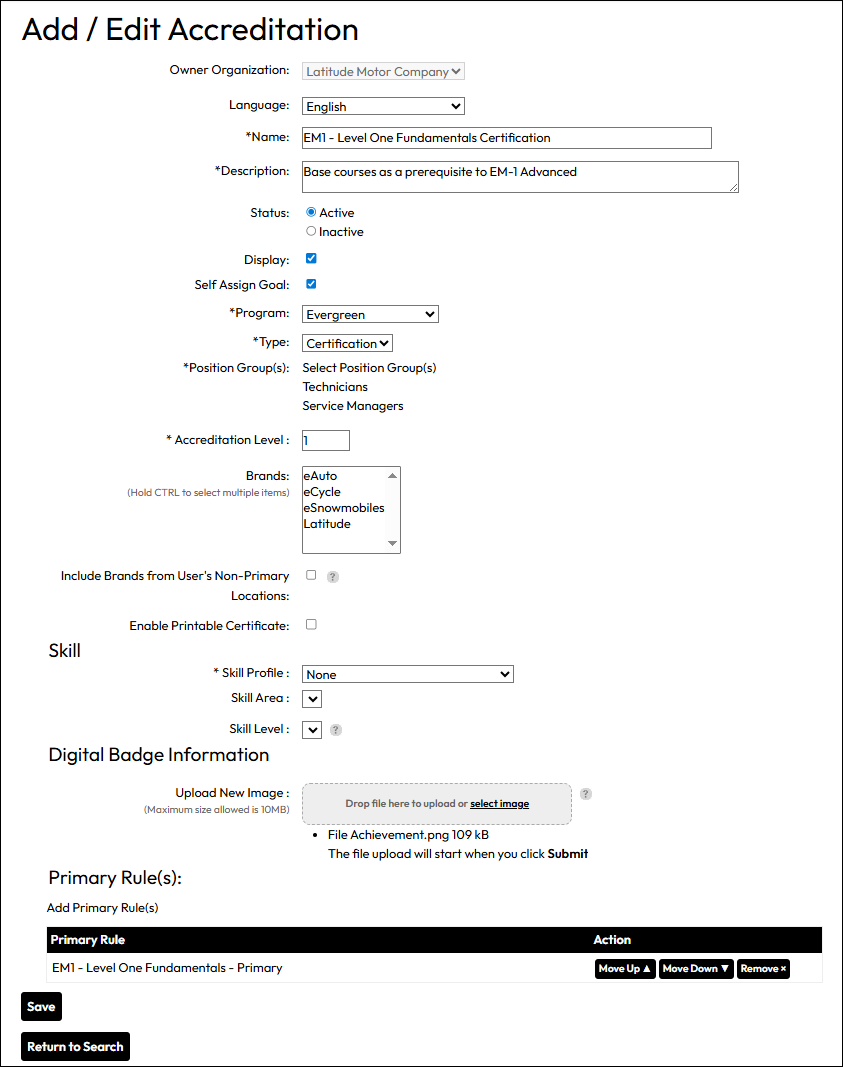
  2. Click +Accreditation. On the “Add/Edit Accreditation” page, enter information in each field as described below. Fields designated with an asterisk are required.
    a. Owner Organization: Display only.
    b. Language: Provide translations for the Name. Default “English” is required.
    c. Name: Enter the official name to display on printable certificates, compliance reports, etc.
    d. Description: Provide brief overview or note important details.
    e. Status: Choose whether the accreditation is Active or Inactive for evaluation.
    f. Display: When left unchecked, this accreditation will be hidden from learners, but still display in administrator tools for reporting and program management purposes.
    g. Self Assign Goal: When checked, the accreditation will be available as a training goal in the Self-Assign Goals wizard and on the student Skills page.
    h. Program: Select the program the accreditation belongs to.
    i. Type: Select Certification, which is the default.
    j. Position Groups:  Click Select Position Groups to open a picker from which you can select the list of eligible user groups.
    k. Accreditation Level: Ordinal used to sort lists in learner’s Certification page. Also determines a user’s “Highest Accreditation Achievement”.
    l. Brands: If your organization has enabled and users Brands, select the brands associated with this particular accreditation.
    m. Include Brands from User’s Non-Primary Location: if enabled, users can achieve an accreditation for brands they are associated with at non-primary location profiles if they belong to the same position group in both the primary and non-primary profile.
    n. Enable Printable Certificate: When checked, learners can print a certificate of achievement from their Training History page.
  3. Skill Section: Under Skill Profile, select None. These are only relevant to curricula.
  4. Digital Badge Information
    Click Upload New Image to add a downloadable achievement badge that will appear in the user’s training history and on the Accreditation slide-in. Badge Image Requirements:
    • File Format: PNG
    • Aspect Ratio: Square
    • Minimum Resolution: 256 x 256 pixels
    • Optimal Resolution: 400 x 400 pixels
    • File Size Limit: 60 MB
    • Background: Transparent recommended
  5. Primary Rules Section: Click Add Primary Rules to open a picker from which you can select the list of certification requirements. Select and check out to add them to the certification rules list.
  6. Once you have added primary rules, use the Move Up, Move Down, Remove buttons to manage list items and display order.
  7. Click Submit.

What’s next?

Creating the certification-style accreditation establishes learning requirements but it does not automatically assign the requirement to the target students in relevant position groups. To to that, you must create Accreditation Ad Hoc (one time) or Rule-based (scheduled) Goals. 

Learn more about these options:
Ad Hoc Accreditation Goals
Accreditation Goal Rules